
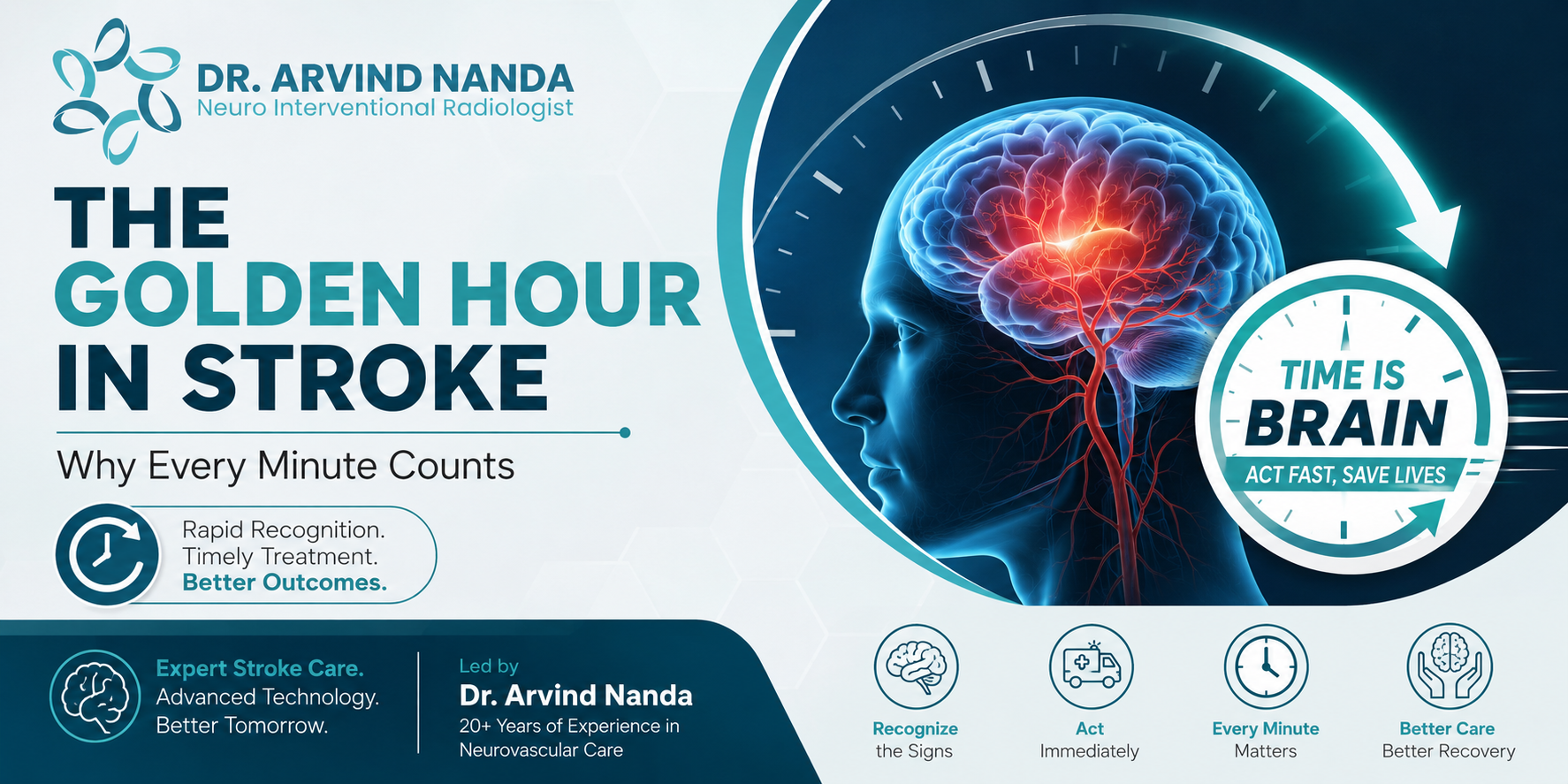
When a stroke strikes, every minute matters. Rapid recognition, timely diagnosis, and appropriate treatment can make a significant difference in protecting brain function and reducing the risk of long-term disability.
For patients seeking Brain Stroke Treatment at Amrita Hospital Faridabad, access to experienced neurovascular specialists is an important part of comprehensive stroke care. Dr. Arvind Nanda, Senior Consultant in Interventional Neuro and Vascular Radiology at Amrita Hospital, Faridabad, has over 20 years of experience in managing complex neurovascular disorders, including conditions requiring advanced endovascular treatment.
What Is the Golden Hour in Stroke?
The golden hour refers to the critical early period after stroke symptoms begin, when rapid assessment and treatment can significantly influence outcomes.
A stroke occurs when blood flow to part of the brain is interrupted or when a blood vessel in the brain ruptures.
In an ischemic stroke, a blood clot blocks an artery. Brain cells beyond the blockage are deprived of oxygen and nutrients. The longer the blood supply remains interrupted, the greater the risk of permanent brain injury.
This is why doctors often say:
“Time is brain.”
The faster a stroke is recognized and treated, the greater the opportunity to protect vulnerable brain tissue.
Recognizing a Stroke: Don’t Wait
Stroke symptoms can appear suddenly and may include:
- Facial drooping
- Weakness or numbness in one arm or one side of the body
- Difficulty speaking or understanding speech
- Sudden vision problems
- Loss of balance or coordination
- Difficulty walking
- Sudden severe headache, particularly when associated with neurological symptoms
Remember FAST
F – Face: Ask the person to smile. Does one side of the face droop?
A – Arms: Ask them to raise both arms. Is one arm weak or drifting downward?
S – Speech: Ask them to repeat a simple sentence. Is their speech slurred, confused, or difficult to understand?
T – Time: If these symptoms appear suddenly, seek emergency medical attention immediately.
Do not wait to see whether the symptoms improve.
What Happens After Reaching the Hospital?
Once the patient reaches the hospital, doctors must quickly determine what type of stroke has occurred and whether emergency treatment is required.
Stroke is broadly classified into:
1. Ischemic Stroke
This occurs when a blood clot blocks blood flow to part of the brain.
2. Hemorrhagic Stroke
This occurs when a blood vessel ruptures and causes bleeding in or around the brain.
Because the treatments are different, rapid diagnosis is essential.
Depending on the patient’s condition, doctors may use:
- CT brain
- CT angiography
- CT perfusion
- MRI and MR angiography in selected cases
- Blood investigations
- Neurological and vascular assessments
These investigations help doctors identify the location of the problem, determine whether a major blood-vessel blockage is present, assess the brain tissue at risk, and decide whether the patient may benefit from specific emergency treatments.
Advanced Brain Stroke Treatment at Amrita Hospital Faridabad
For eligible patients with acute ischemic stroke, modern treatment may focus on restoring blood flow to the brain as quickly as possible.
Intravenous Thrombolysis
In selected patients, clot-dissolving medication may be administered intravenously within an appropriate treatment window.
The sooner an eligible patient is assessed, the greater the opportunity to restore circulation before irreversible brain damage progresses.
Mechanical Thrombectomy
Some severe ischemic strokes occur because a large blood vessel in the brain becomes blocked.
In appropriately selected patients, mechanical thrombectomy may provide an important treatment option.
This minimally invasive endovascular procedure involves guiding a specialized catheter through the blood vessels toward the clot. The clot can then be retrieved to restore blood flow to the brain.
Mechanical thrombectomy has significantly changed the treatment of selected large-vessel occlusion strokes.
However, it is not appropriate for every patient. Eligibility depends on factors such as the location of the blockage, brain imaging findings, clinical condition, time since symptom onset or last-known-well time, and other individual considerations.
Dr. Arvind Nanda: Experienced Neurointerventional Specialist
Effective stroke treatment requires more than simply identifying that a stroke has occurred. Complex cases may require expertise in brain imaging, cerebral blood vessels, neurointerventional procedures, and endovascular treatment.
Dr. Arvind Nanda is a highly experienced Senior Consultant in Interventional Neuro and Vascular Radiology with more than 20 years of experience in treating complex neurovascular disorders.
His qualifications and advanced training include:
- MBBS
- D.M.R.E.
- MD in Radiodiagnosis
- PDCC in Interventional & Vascular Radiology
- Senior Residency in Neuroradiology at AIIMS, New Delhi
- Advanced training in France, the USA, the UK, and Switzerland
He currently serves as a Senior Consultant at Amrita Hospital, Faridabad.
His expertise in interventional neuro and vascular radiology is particularly relevant to patients who may require advanced evaluation or minimally invasive endovascular treatment for complex neurovascular conditions.
For individuals searching for Brain Stroke Treatment at Amrita Hospital Faridabad, timely access to appropriate imaging, neurological assessment, and experienced neurovascular care can be crucial during an acute stroke.
The Clock Starts Before You Reach the Hospital
The golden hour does not begin when the patient reaches the emergency department.
The clock starts when the symptoms begin—or, in certain situations, when the person was last known to be well.
This information can be extremely important for the treating team.
If possible, remember:
When was the person last completely normal?
For example, if someone was speaking normally at 8:00 AM and developed speech difficulty at 8:30 AM, tell the emergency medical team.
Even a delay of minutes can affect treatment decisions.
What If the Person Wakes Up With Stroke Symptoms?
A stroke can occur while someone is asleep. A person may go to bed normally and wake up with weakness, speech difficulty, vision problems, or other neurological symptoms.
This is known as a wake-up stroke.
Although the exact time of stroke onset may be unknown, treatment may still be possible for selected patients. Modern stroke evaluation uses clinical assessment and advanced brain and blood-vessel imaging to determine whether specific treatments may be appropriate.
Therefore:
Unknown onset does not mean “do nothing.”
Urgent medical assessment is still necessary.
Why “Wait and Watch” Can Be Dangerous
Stroke symptoms may sometimes improve temporarily. However, this does not necessarily mean that the danger has passed.
A temporary episode of neurological symptoms may represent a transient ischemic attack (TIA), which can be an important warning sign of a future stroke.
Similarly, apparently mild symptoms may be associated with a significant blood-vessel problem.
If sudden neurological symptoms appear:
Don’t wait for them to become worse.
Don’t wait for them to disappear.
Don’t try to diagnose the problem at home.
Seek emergency medical attention immediately.
Brain Stroke Treatment Is Not One-Size-Fits-All
Every stroke is different.
Treatment depends on:
- Type of stroke
- Location of the affected blood vessel
- Size and location of the brain injury
- Presence of a large-vessel blockage
- Time since symptoms began or last-known-well time
- Brain imaging findings
- Age and overall health
- Other medical conditions
- Individual treatment eligibility
This is why stroke treatment needs to be personalized.
The important question is not simply:
“What is the best stroke treatment?”
It is:
“What treatment is appropriate for this particular patient, at this particular moment?”
What Families Should Do When Stroke Symptoms Appear
1. Recognize
Look for sudden facial weakness, arm weakness, speech difficulty, vision changes, dizziness, or loss of balance.
2. Note the Time
Record when the symptoms were first noticed—or when the person was last known to be normal.
3. Act Immediately
Seek emergency medical care without unnecessary delay.
4. Don’t Self-Medicate
Do not assume the symptoms are caused by blood pressure, weakness, dehydration, or another minor problem.
5. Reach Appropriate Stroke Care
Choose a facility capable of rapid neurological assessment, brain imaging, and advanced stroke management when required.
The Golden Hour Is About Protecting Brain Function
The phrase “golden hour” is ultimately about more than time.
It is about preserving the ability to speak, walk, work, interact with family, and maintain independence.
Rapid recognition and treatment can give eligible stroke patients a better opportunity to receive appropriate care before irreversible brain injury progresses.
Final Takeaway
A stroke does not wait for a convenient time.
And neither should we.
If you notice sudden facial drooping, weakness, speech difficulty, vision changes, severe imbalance, or other unexplained neurological symptoms, treat them as an emergency and seek medical care immediately.
For those seeking Brain Stroke Treatment at Amrita Hospital Faridabad, timely assessment by an experienced neurovascular team is an important step toward appropriate diagnosis and treatment.
With his extensive experience in Interventional Neuro and Vascular Radiology, Dr. Arvind Nanda provides specialized expertise in the evaluation and management of complex neurovascular conditions at Amrita Hospital, Faridabad.
Recognize the signs. Remember the time. Act without delay.
Because when it comes to stroke, every minute counts.
This article is intended for general health awareness and does not replace emergency medical evaluation or individualized medical advice.