
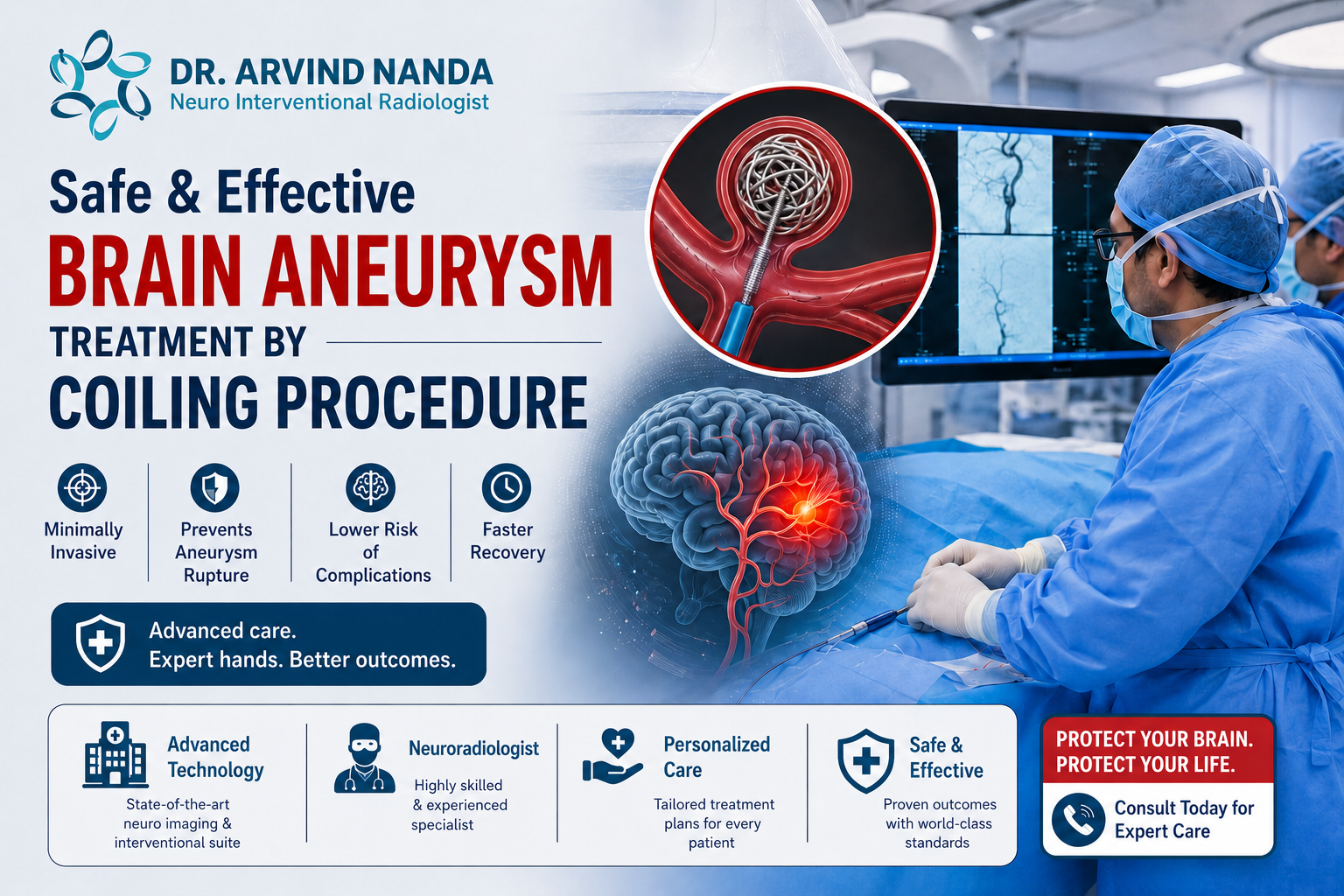
Brain Surgery Coiling Aneurysm Treatment in Faridabad – Dr. Arvind Nanda
Introduction 🧠
A brain aneurysm is an ailment in the neurology field where a section of a blood vessel develops into a swelling due to weakness. If this bursts, it may result in bleeding in the brain, causing a potentially deadly medical emergency.
In modern times, brain surgery aneurysm coiling treatment in Faridabad has become an innovative and viable procedure. With less risk, faster recovery, and more safety when compared to conventional brain surgery, this procedure is more reliable. Visiting a qualified doctor such as Dr. Arvind Nanda can be highly recommended.
🧠 What is Coiling Treatment for Brain Aneurysm?
Coiling is an advanced technique where small platinum coils are inserted into the aneurysm. This helps in preventing blood flow within the aneurysm and prevents its rupture.
This is viewed as a relatively safer option to traditional surgery methods, particularly for patients who may not make good surgery candidates.
🔍 Causes of Brain Aneurysm
🌟 High blood pressure
🌟 Smoking
🌟 Genetic factors
🌟 Aging
🌟 Head injury
⚠️ Symptoms to Watch
🔹 Before Rupture
💠 Persistent headache
💠 Blurred or double vision
💠 Neck pain
💠 Nausea
🔹 After Rupture
🔥 Sudden severe headache
🔥 Vomiting
🔥 Loss of consciousness
🔥 Seizures
⚙️ How the Coiling Procedure Works
🚀 Step 1: Catheter Insertion
A thin catheter is inserted through the groin artery.
🧭 Step 2: Navigation
The catheter is guided to the brain using advanced imaging technology.
🧩 Step 3: Coil Placement
Soft platinum coils are placed inside the aneurysm.
🔒 Step 4: Sealing the Aneurysm
The coils promote clot formation and seal the aneurysm effectively.
✅ Benefits of Brain Surgery Coiling Aneurysm Treatment in Faridabad
✔️ Minimally invasive procedure
✔️ Faster recovery time
✔️ Less pain and discomfort
✔️ Short hospital stay
✔️ Lower risk compared to open surgery
📊 Coiling vs Open Surgery
| Feature | Coiling | Open Surgery |
| Procedure Type | Minimally invasive | Major surgery |
| Recovery Time | Fast | Longer |
| Risk Level | Lower | Higher |
| Hospital Stay | Short | Long |
🧑⚕️ Who is a Suitable Candidate?
🎯 Patients diagnosed with brain aneurysm
🎯 Ruptured aneurysm cases
🎯 High-risk surgical patients
🎯 Elderly individuals
For proper evaluation and treatment planning, experts like Dr. Arvind Nanda are recommended.
🏥 Recovery Process
🏨 Hospital stay: 1–3 days
🙂 Mild discomfort or headache
⚡ Quick return to daily activities
Recovery Tips
🛌 Take proper rest
❤️ Keep blood pressure under control
🚭 Avoid smoking
📅 Follow regular check-ups
⚠️ Possible Risks
⚠️ Blood clot formation
⚠️ Stroke risk
⚠️ Infection
⚠️ Rare coil displacement
🔬 Diagnosis Methods
🔍 MRI scan
🔍 CT scan
🔍 Cerebral angiography
🛡️ Prevention Tips
🥗 Maintain healthy blood pressure
🚫 Quit smoking
🥦 Follow a balanced diet
🏃 Exercise regularly
🧘 Manage stress effectively
❓ FAQs
Q1: Is coiling a safe procedure?
💡 Yes, it is a widely used and safe technique when performed by an experienced specialist.
Q2: How fast is recovery?
💡 Most patients recover within a few days and return to normal activities.
Q3: Is it suitable for everyone?
💡 Not always. A doctor’s evaluation is necessary to determine the best treatment.
Dr. Arvind Nanda
Dr. Arvind Nanda is an expert doctor in Interventional Neuro & Vascular Radiology with more than 20 years + of experience in providing complex neurological vascular intervention treatments. He did his MBBS, DMRER, and MDfrom Sri Ramachandra Medical College and Research Institute, Chennai and even practiced in AIIMS, New Delhi
He treats various conditions including Acute Stroke, Brain Haemorrhage, Brain Aneurysm, Carotid Artery Stenosis, etc. Additionally, he completed an Advanced Neuroradiology Program from University Hospital, Zurich, Switzerland
📝 Conclusion
📝 Conclusion
Brain aneurysm surgery coiling treatment in Faridabad is safe and highly effective in treating brain aneurysms. It is a sophisticated procedure that minimizes any risk involved in the surgery.
Selecting appropriate diagnosis and quality care, particularly under specialists such as Dr. Arvind Nanda, will prove advantageous.